anotherSerif
By Xiaoyuan Gao
2026
2 subfamilies
(Standard, Ornament)
6 styles
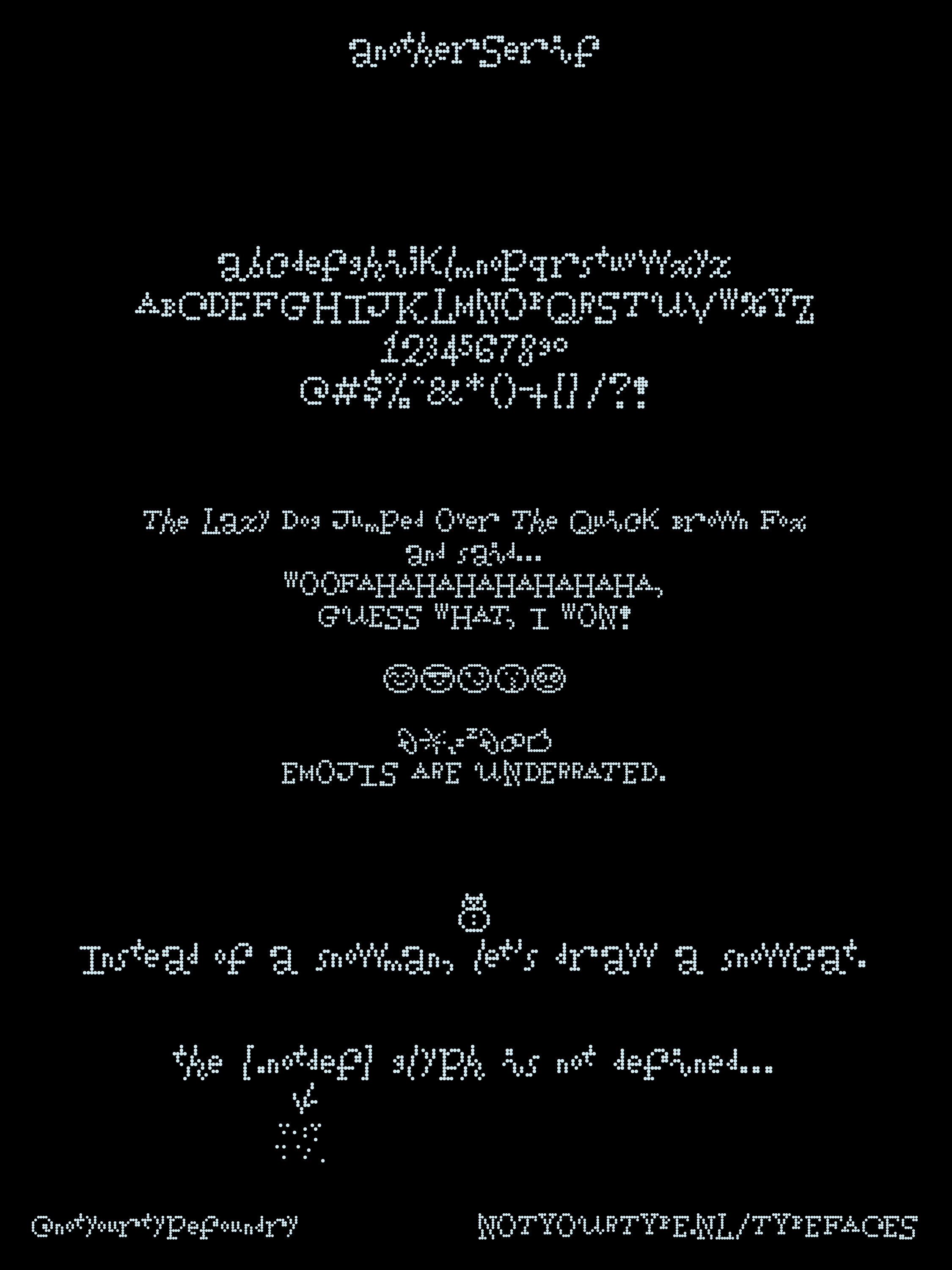
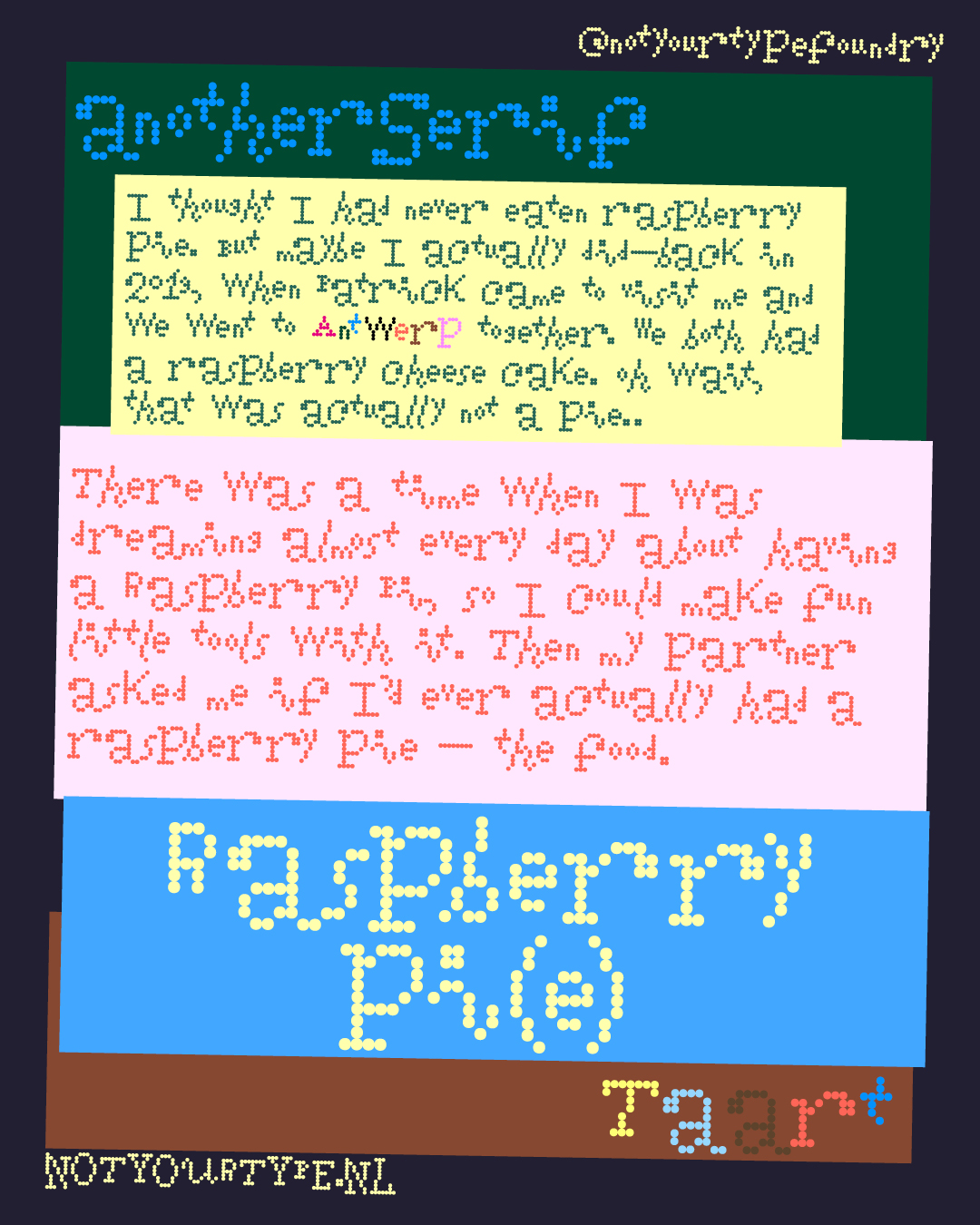
There are so many serif typefaces—today Xiaoyuan is adding one more to the pile: anotherSerif. This is her first attempt at a serif typeface—well, mostly serif. Most glyphs follow serif conventions, but some don't.
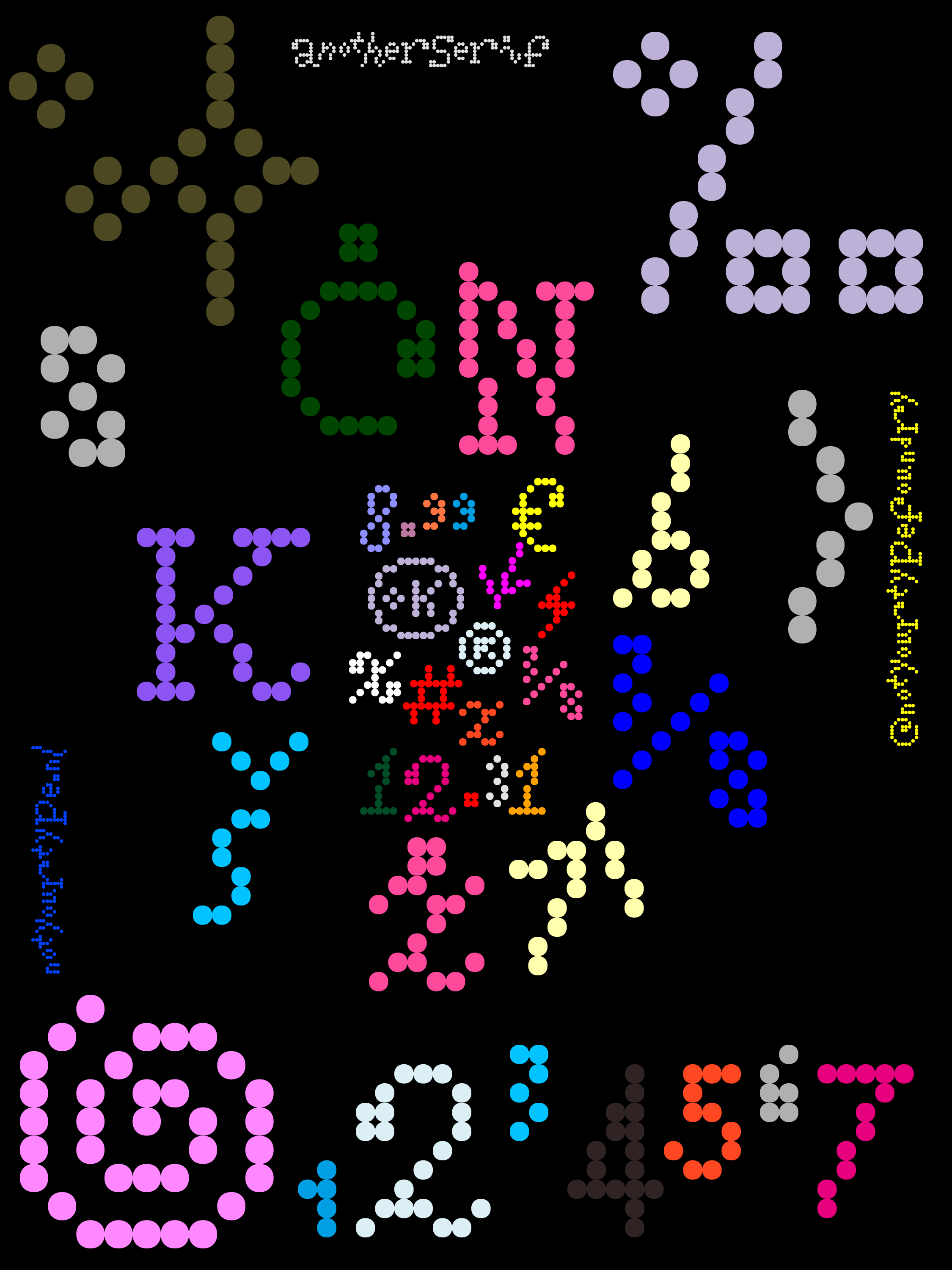
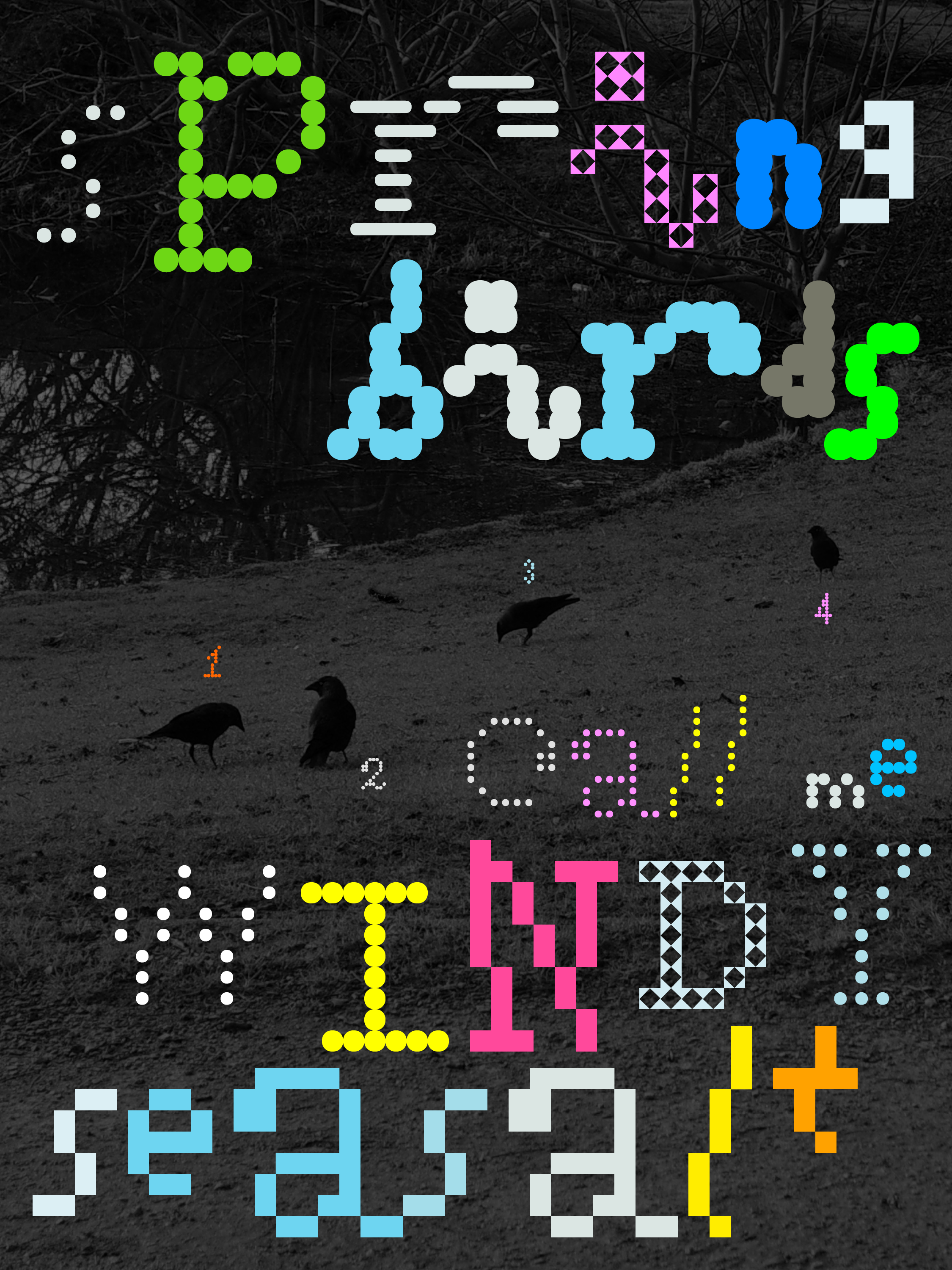
anotherSerif is a typeface that explores irregularity and inconsistency, qualities often overlooked or under appreciated. Each glyph has its own size, sometimes breaking all conventions: for example, the uppercase P is smaller than lowercase p. As a dot matrix-based typeface, this irregularity surprisingly helps readability at small sizes.
The challenge was finding the right rhythm within this chaos. There were technical constraints when bitmap fonts were introduced. Now we don't have those constraints anymore—wouldn't it be nice to do something weird? After commonSans, it felt natural to make anotherSerif. :)
anotherSerif
(3 styles)
anotherSerif notLight
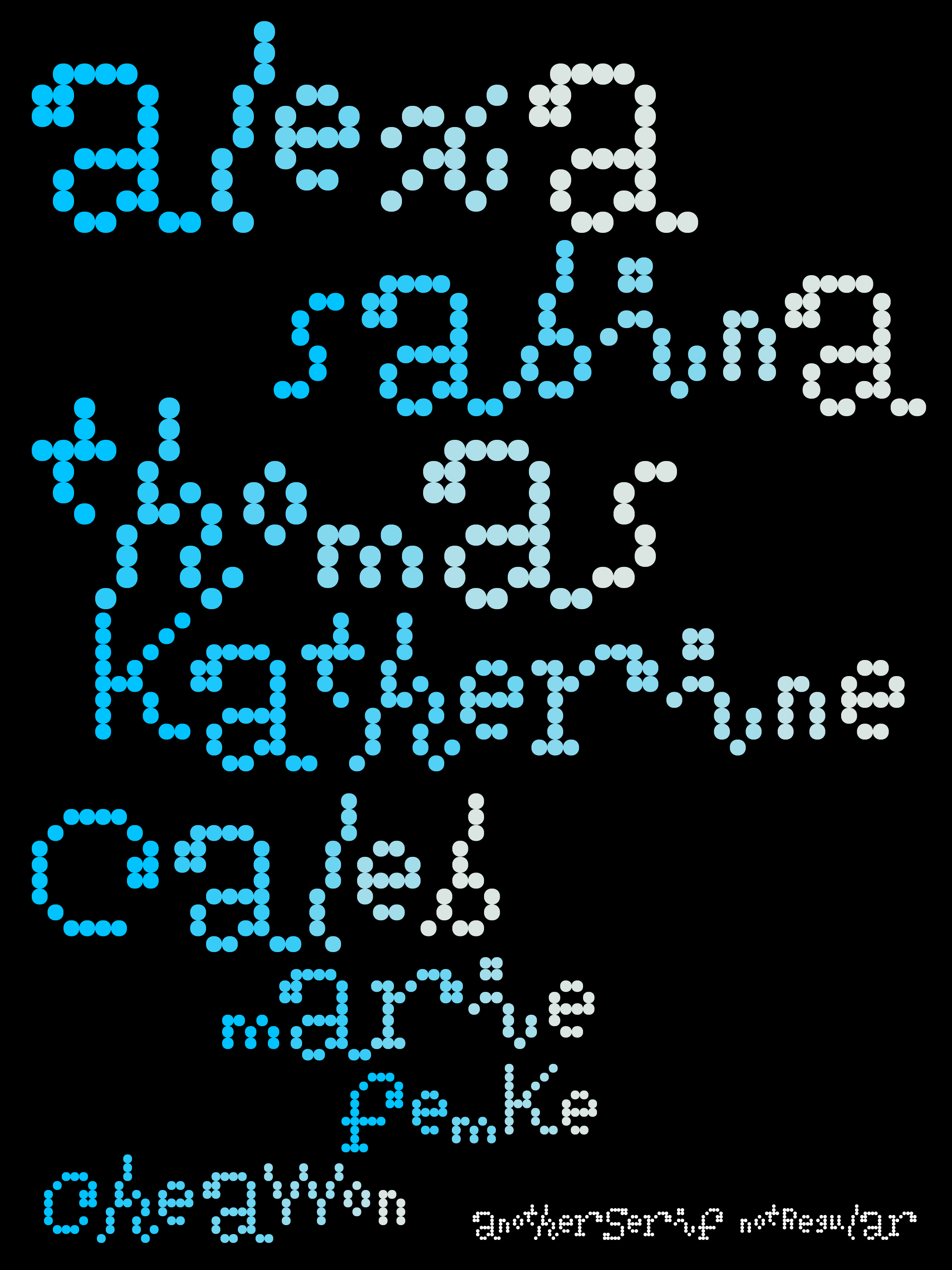
anotherSerif notRegular
anotherSerif notBold
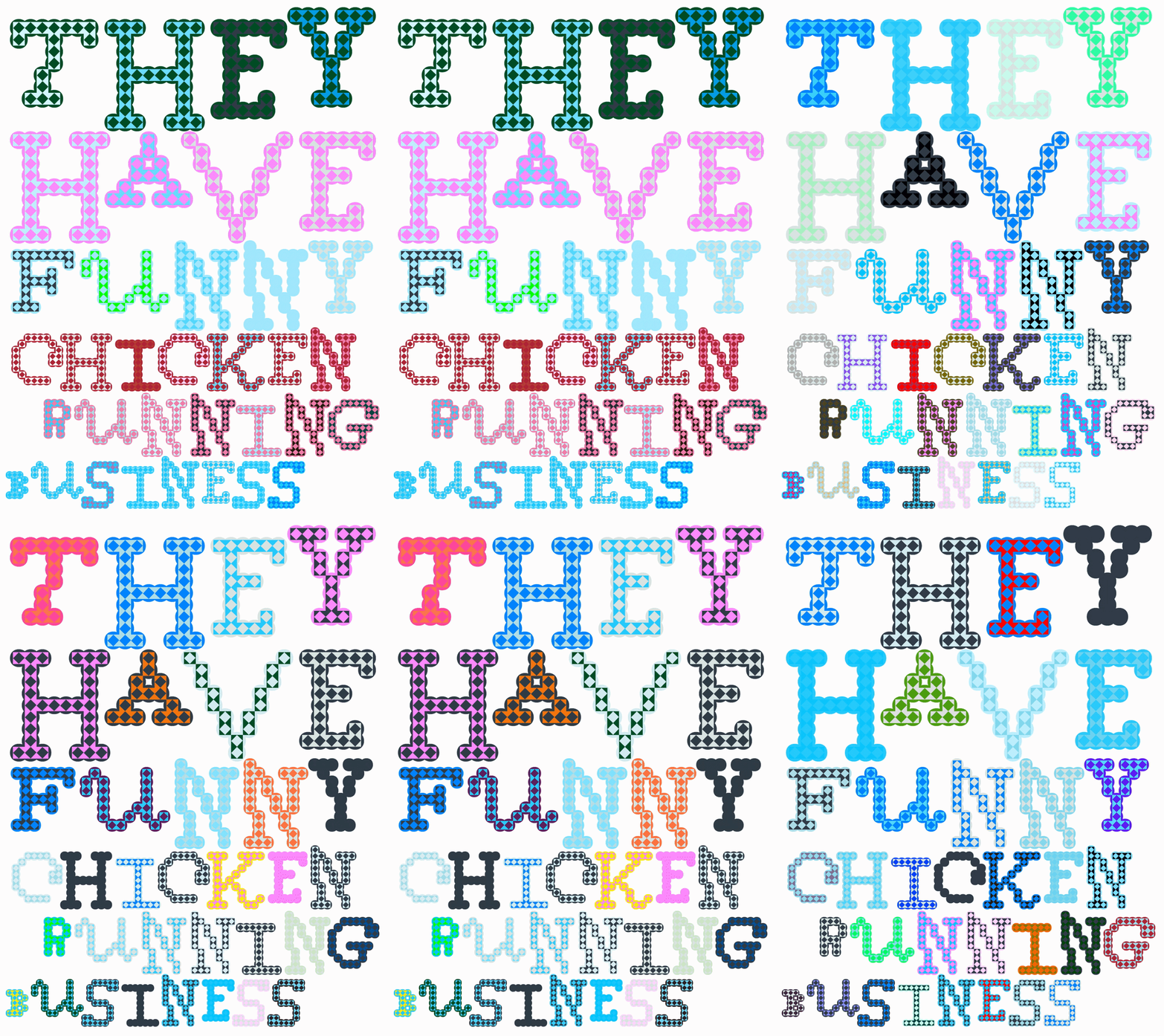
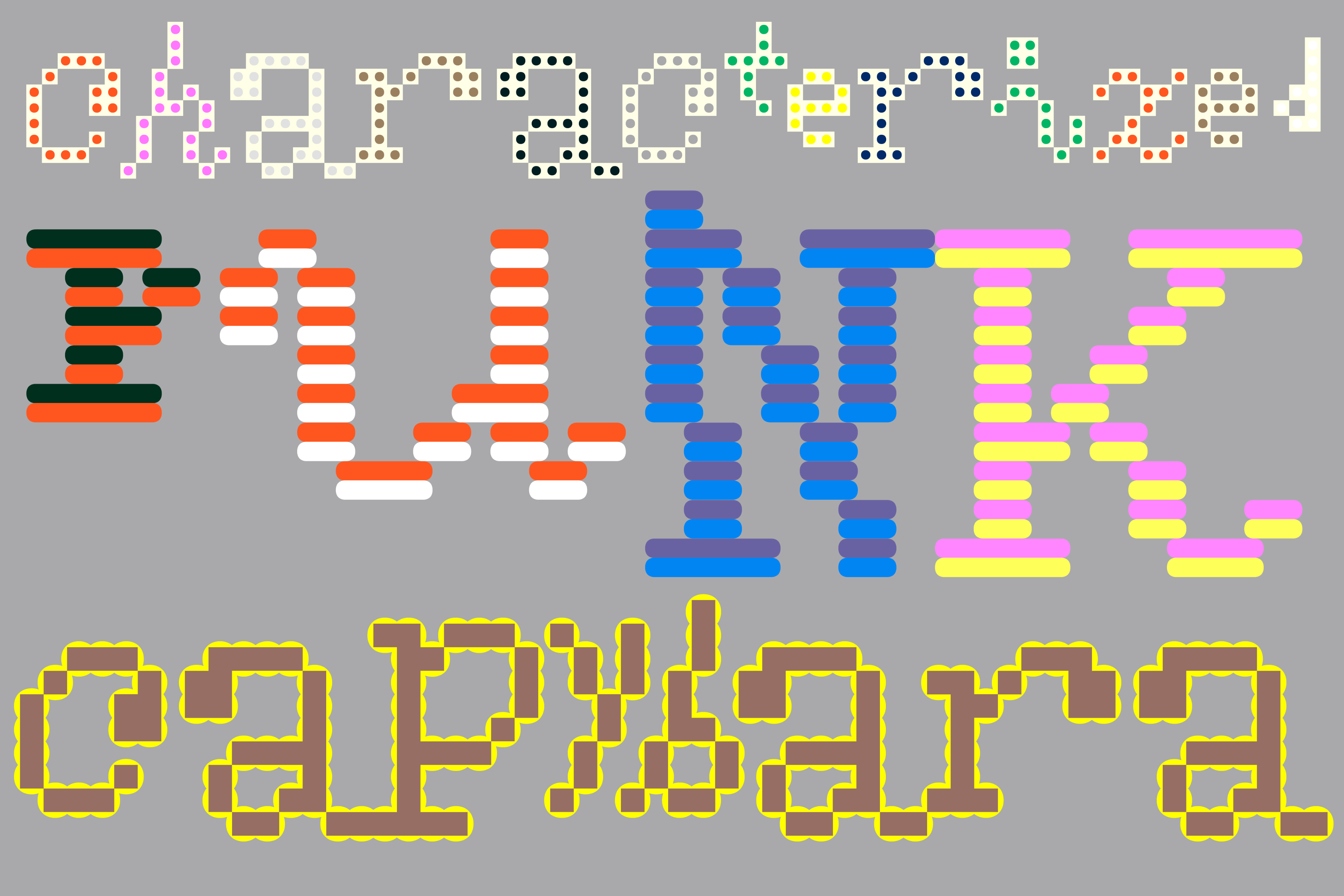
anotherSerif Ornament
(3 styles)
anotherSerif Arlequin
anotherSerif Box
anotherSerif CRT
anotherSerif notRegular
The aspect ratio of an image is the ratio of its width to its height, and is expressed with two numbers separated by a colon, such as 16:9, sixteen-to-nine. For the x:y aspect ratio, the image is x units wide and y units high. Common aspect ratios are 1.85:1 and 2.39:1 in cinematography, 4:3 and 16:9 in television photography, and 3:2 in still photography. The common film aspect ratios used in cinemas are 1.85:1 and 2.39:1. Two common videographic aspect ratios are 4:3 (1.3:1), the universal video format of the 20th century, and 16:9 (1.7:1), universal for high-definition television and European digital television. Other cinema and video aspect ratios exist, but are used infrequently. In still camera photography, the most common aspect ratios are 4:3, 3:2, and more recently found in consumer cameras, 16:9. Other aspect ratios, such as 5:3, 5:4, and 1:1 (square format), are used in photography as well, particularly in medium format and large format. With television, DVD and Blu-ray Disc, converting formats of unequal ratios is achieved by enlarging the original image to fill the receiving format’s display area and cutting off any excess picture information (zooming and cropping), by adding horizontal mattes (letterboxing) or vertical mattes (pillarboxing) to retain the original format’s aspect ratio, by stretching (hence distorting) the image to fill the receiving format’s ratio, or by scaling by different factors in both directions, possibly scaling by a different factor in the center and at the edges (as in Wide Zoom mode). In motion picture formats, the physical size of the film area between the sprocket perforations determines the image’s size. The universal standard (established by William Dickson and Thomas Edison in 1892) is a frame that is four perforations high.
anotherSerif notRegular
anotherSerif notRegular
anotherSerif notRegular
🌀🌱🎵🐤👀👉👍💌💤💥💫🔃🔄🔗😊😎😏😒😕😖😗😶😺🙂🙃🙄🚫🛑☃↑↗→↘↓↙←↖↔↕↩↪
anotherSerif notRegular
Whatever hour you woke there was a door shutting. From room to room they went, hand in hand, lifting here, opening there, making sure—a ghostly couple. "Here we left it," she said. And he added, "Oh, but here too!" "It's upstairs," she murmured. "And in the garden," he whispered. "Quietly," they said, "or we shall wake them."
anotherSerif notLight
Do bạch kim rất quý nên sẽ dùng để lắp vô xương
anotherSerif notRegular
anotherSerif notBold
anotherSerif notLight
two slices of BUTTERED bread
anotherSerif notBold
ARLEQUIN or Harley Quinn?
anotherSerif Ornament Arlequin
anotherSerif Ornament Box
anotherSerif Ornament CRT
anotherSerif Ornament CRT
anotherSerif Ornament Box
THE REBELLION OF PEANUT BUTTER
anotherSerif Ornament Arlequin
anotherSerif notRegular
Viime yönä ongin purossa jo kahdelta.
anotherSerif notBold
Voix ambiguë d’un cœur qui au zéphyr préfère les jattes de kiwis
anotherSerif notLight
type here
Specimen
Overlay | comination of two styles
About anotherSerif's designer
Xiaoyuan Gao (She/Her) is a Rotterdam-based freelance graphic designer, image-maker, type designer and the initiator of “notyourtypefoundry”. While experimenting with unconventional approaches to type design and typesetting, she sees type design as a tool making process.
Buy anotherSerif
License prices scale with company size—larger companies pay more per license. See our EULA for details.
All prices excl. VAT